Showing posts with label Travels around the world. Show all posts

Friday, October 21, 2011

London markets

Just look at that gorgeous striped trunk and vintage dress form!

I love London. At a mere 2 hours away by Eurostar its ideal for quick weekend getaways.  There's always so much to see and do that I have a hard time narrowing down my choices. Of course my hands down favorite activity to do is to visit the London antique markets.  But please don't make me compare between my beloved Parisian ones and London because that would be a hard one to make. 

During my recent visits, I made sure to visit the famed Portobello Market and was suitably impressed by all the collectibles one can find there.  I had to physically restrain myself from grabbing a million things!
tea anyone?
I'm not a plate and silverware sort of person, but I did spend some time perusing this person's collection.  Pretty pretty decorative items that would look good in anyone's home.
And these vintage buses and scooters are cool, aren't they?
Course' it wouldn't be complete if I didn't check out all the fashion.  Happy to say that our french selection more than holds its own but there were some pretty nice hats at this stall...

Next stop was the Camden Lock  Market. I have to confess, I was disappointed here.  I had high expectations and was disappointed to see that the market was overrun with what looked like cheap clothing.  A chat with some local stall holders confirmed my fear that most of those selling handmade and unique items had long left Camden Lock.

a view of the Lock
Nevertheless we did a quick look and I did find a small section inside the Stables with what looked like some antiques.

I loved this little valise, wished I had room for it in my luggage!
And this one stall had the perfect rummage through bins with all sorts of bits and bobs.
More glassware..
And teacups displayed in an original way.


After the disappointment over at Camden Market, I wasn't sure what to expect from Camden Passage. But happily, it was a completely different place. Its very small compared to Portobello and Camden Market but it was full of proper little antique shops selling all sorts of things and stalls with interesting little items.
This one was a fancy store selling beautiful silver ware.
A more budget friendly place was this one with wooden cabinets and curios inside.
A gorgeous vintage store filled with delightful dresses and retro shoes.
And what had to be the oddest one of all, was this store with a...stuffed dog (yes, you read that right) at the window.  Isn't that the creepiest , funniest thing you ever did see?  Though I don't know why I should find it so strange, Deyrolle does the same thing and people think its the fanciest store ever! 

Wednesday, October 12, 2011

Pretty Frigiliana

Just before leaving  Spain, we decided to do one last day trip to the town of Frigiliana. It is a small pretty town in the Almihara, Tejada and Alhama mountains.  It is one of the prettiest of Andalucia's white villages.

Its moorish past is evident in the maze of narrow cobblestoned paths that are full of hidden corners and alleyways that now lead to tapas bars and restaurants.   And because it is in the mountains, the paths are often steep; all the better for walking off the calories after consuming one too many of those delicious tapas.
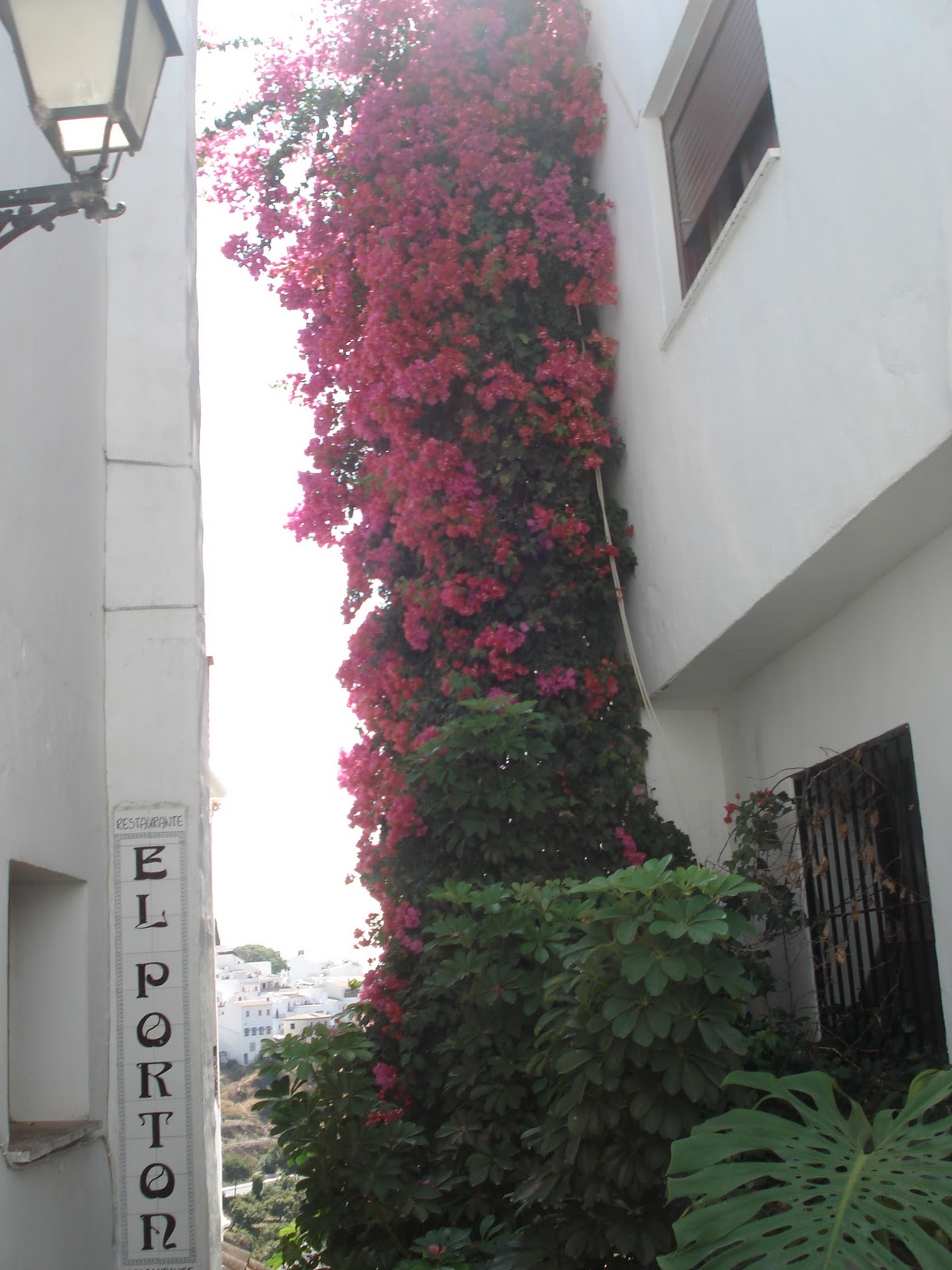
And while practically the entire village is white washed, there are splashes of brilliant color everywhere..

All in all a wonderful day jaunt and an excellent way to leave Spain!

Thursday, October 6, 2011

A little coastal town


For us, vacation wouldn't be complete without a few days by the sea; soaking up the sun and breathing in the bracing sea air always does us a world of good. And along the Costa del Sol there are plenty of places to choose from.  But this sun-filled part of the world hasn't remained undiscovered. All along the coast there are huge apartment buildings for the hundreds of people coming to partake of the sun and sea.  Every possible cove, islet and beach is literally filled with people.  Luckily for us, by the time we arrived, most of the crowd had left.  And we managed to find a town, more charming and relaxed than the other towns. We found ourselves in Nerja.


Playa Calahonda
Nerja has a long history. Its main claim to fame, aside from its beaches of course, is the Cave of Nerja which has primitive drawings and contain remnants of ancient dwellings. The Romans too settled here and built three settlements.  During the years of Islamic rule, Nerja was famous for its silk. It was renowned all the way to Damascus.  In more recent history, Nerja remained relatively untouched by the crazy construction boom of the 70s and 80s because it was unconnected by highway to the rest of Andalucia till the late 80s.  It has since caught up thanks in part to its beautiful beaches which lie dramatically against high cliffs.

Playa el Salon
But despite this influx of tourists, Nerja remains a town with its own rhythms and a daily life far from the crazy crowd who invade the town during the summer months.  It was at Nerja that I found a shop called Manos selling artisanal leather bags made completely by hand in a tiny atelier.  Unfortunatey I wasn't allowed to take pictures of their beautiful bags but I did get a picture of the designer at work.  It is a family run business that has been selling out of Nerja since 1974.  Their only other shop is in an even tinier town called Frigiliana up on the mountain.  


And here you will still see the quiet pleasures of dancing cheek to cheek with your beloved to the strains of traditional Spanish music,


and nightime strolls along the Balcon d'Europa is a part of the daily ritual of those who live there the whole year round.


Monday, October 3, 2011

The Albayzin


While the Alhambra is probably the most visited spot in the whole of Granada, the city has a less discovered treasure and this is the Albayzin, Granada's old Muslim quarter located on top of a hill just opposite that of the Alhambra.  It was founded in 1227 when the Muslims of Baeza moved to Granada after Christian forces overran the city. And it continued to survive even after the Christian conquest in 1492.


The Albayzin as seen from the Alhambra

an old store sign

Friday, September 30, 2011

The pearl of Granada


An old gentleman and his wife were taking a walk, taking in the sights of Granada when they saw an blind beggar. Moved by this sight, the man turned to his wife and said "Give him alms, my wife, for there is no pain in life greater than to be a blind man in Granada."--Francisco de Icaza


How to begin describing the wonders that you find within this complex of fortress and palace on top of the hill called La Sabika? I am afraid my words will not be enough nor my pictures sufficient to convey the beauty, the delicacy and magnificence but I would like to try...


Before one even gets to see the Palacio Nazaries, the path wends along the the gorgeous Generalife gardens and you get glimpses of the city far below framed against the backdrop of the Sierra Nevada mountains. But finally through this red stone gate, the visit to the Palace begins.


 And its plain exterior belies the wonders that are inside.  Inside, every facade us covered with beautiful glazed tiles and ornate carved wood.
Patio de los Arranyanes
Every room is richly decorated and Islamic artists spared no efforts to turn everything into a feast for the eyes. Its hard to believe that the Alhambra was originally built as a fortress in the 9th century. In the 13th and 14th centuries when Granada was the last bastion of Islamic might in the Iberian peninsula, the emirs converted the fortress into a palace complex.  They wanted not only a strong place from which to rule but also a palace that would display the very best of their arts. 

Its hard to walk through these rooms and not be transported.  Gazing out of the filigreed windows and taking in the highly ornamented walls, I can well imagine the rulers of old taking their leisure here or better yet, ruling their empire.


Everywhere in the Alhambra you see the mingling of art and religion.  The two are so closely intertwined as to be inseparable. In the Salon de Comares, the room's domed ceiling contains more than 8000 pieces of cedar in a pattern of stars that represent the seven heavens of Islam. It also represents the complexity of Allahs infinite universe.


Islamic artists filled every wall with religious messages rendered in beautifully carved Arabic script . One phrase "Only Allah is victorious" is repeated 9000 times.
An example of the scrollwork

And the palace within the Courtyard of Lions represents the Islamic paradise which is divided into found parts by rivers.


Palacio de los Leones
A glimpse of the ceiling
These master artisans also filled the Alhambra with water. This precious element can be found in the different pools of the many patios of the palace.  In the searing heat of the Andalucian sun, its the perfect way to refresh oneself.

Tuesday, September 27, 2011

Come stroll with me

The view from the Puerta de Almodovar
 Exploring the medieval lanes around the Mezquita means opening up your senses.... .

There are romantic paths


with fragrant flower bedecked walls,

old patios richly decorated with ornate tiles and flowers from where rich cooking smells waft out,

quiet courtyards with splashes of brilliantly colored flowers and only birdsong to disturb the calm,


beautiful stone fountains

 and pools,


 And arched doorways leading to secret hidden places.

Monday, September 26, 2011

La Mezquita


one of the 19 doors of the Mezquita
For our summer holidays, we decided to continue with the Spanish theme which started back in June in Madrid. This time around we went south to explore Andalusia and what better way than to start with Cordoba.  

Cordoba, (along with Granada, but this is a subject for another post), has always seemed to me to be a place of myth and legend, not to mention history.  During Roman times, Cordoba ruled the Andalucian province and its wealth was legendary. Little surprise then that the Muslim invaders chose to invade Cordoba in 711. From then until the 11th century, Cordoba was the capital city of Muslim presence in the Iberian peninsula.  At its peak in the 10th century, Cordoba was famed for the peaceful and harmonious co-existence of three religions--Islam, Judaism and Christianity.  It had the best universities, libraries and mosques, the most dazzling of which is the Mezquita.


Here one enters into a magical place, a forest, if you will, of pillars topped by red and white arches. A forest but one filled with space and lightness.  And while I am one of the hundreds of visitors traipsing through its halls, it doesn't take away the feeling of being somewhere hallowed.   Everywhere I turn I see  a different play of light among the pillars and the effect can be overwhelming.  But imagine how luminous it must have been when all of its 19 doors used to be open.


Emir Abd ar-Rahman founded the Mezquita in 785 on the grounds of a Visigothic church but his successors extended the Mezquita until it stood as one of the biggest mosques of its time. Imagine it used to have 1293 columns, of which 856 remain today. The  mihrab or the prayer niche indicate the direction of the Mecca and its wall is gorgeously and richly decorated with "1600 kg of gold mosaic cubes". 

The mihrab portal
After the Christians captured Cordoba,  a cathedral was constructed in the middle of the Mezquita.  And strange as it may seem, the two structures co-exist beautifully. Somehow the pillars and arches of the Islamic Mezquita magnificently set-off the Catholic retablo.  This peaceful co-existence of two religions structures within one is a good lesson for all of us to learn.

The retablo is composed of jasper and marble
Here one can see the juxtaposition of the church on the mosque

One of the halls
Returning to the bright outside world can be a bit disorienting.  So its a good idea to linger a bit in the Patio de los Naranjas  (Courtyard of the Orange Trees) before setting off to explore the charms of the medieval quarter the surrounds the Mezquita.